Nikiamanikia: a little colour, plenty of tattoos and a space to be yourself
Niki Triantafyllopoulou had not planned to become a tattoo artist or open her own studio. Today, she is behind Sisterhood Ink Athens, a space created around art, privacy and safety. We spoke about fresh starts, women’s bodies, stereotypes and everything that happens between the first sketch and the finished tattoo.
A conversation with Sofia Vatista and Dimitra Koumpoura for GYNĒMA
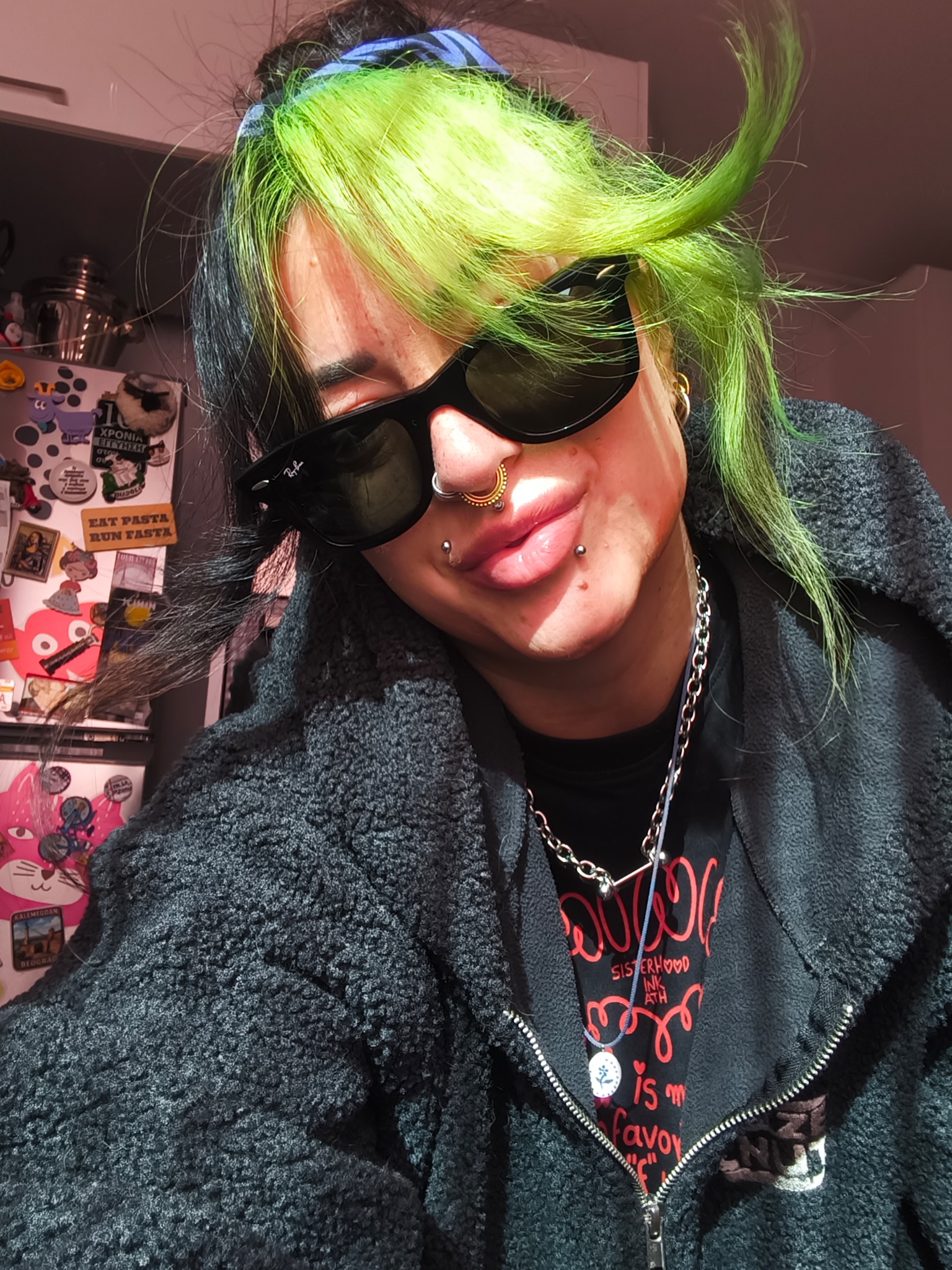
Niki joined our online meeting wearing a T-shirt we liked so much that we commented on it before we had even begun asking our questions.
“Oh, thank you, it’s my own design,” she replied.
There could hardly have been a more fitting start to a conversation with the woman many people know as nikiamanikia.
If you have come across her designs on Instagram, you will probably have noticed the bold colours, female figures, humour and social references. Niki uses illustration and tattooing to talk about body acceptance, feminism and the world around her, among other things. And she feels little need to make her views more palatable just to appeal to everyone.
At forty, having studied graphic design at Vakalo and followed a different career before turning to tattooing, she now finds herself in a chapter of her life she had not quite planned.
We spoke about how a change at 35 can lead you somewhere entirely new, why a tattoo studio can be much more than a place to get a beautiful design, and what it means to work on another person’s body.
There was plenty of laughter, some very honest answers and one reminder that stayed with us: a body is not simply a canvas.
A change at 35, without a grand plan
Some people know exactly what they want to do from an early age. Others discover it along the way.
Niki probably belongs to the second group, at least when it comes to tattooing.
When we asked what made her choose human skin over any other canvas, she explained that the decision had come about almost by chance.
During the pandemic, at around 35, she felt the need to change her professional direction. She already had a creative background, but wanted to try something different.
She began taking classes and workshops, experimented with different art forms and, through meeting a tattoo artist, discovered a field that caught her interest.
She started practising on synthetic skin, still unsure whether she could turn it into a career.
Then she set herself a very specific goal.
If she could not earn her first 50 euros from tattooing, she would not continue.
About a month later, a young woman came along who trusted her to do a tattoo.
Niki kept going.
It is rather funny to think that an entire career change might, at least initially, have depended on such a small amount of money.
But perhaps it is also a realistic picture of how many creative careers begin: not always with complete confidence, but with a little curiosity, plenty of practice and someone willing to give you your first opportunity.
A studio that does not have to look like all the others
Opening her own space had not been part of an original plan either.
Niki had worked in other tattoo studios, but gradually felt she needed a space that was more her own, both in its appearance and in the way it operated.
That is how Sisterhood Ink Athens came into being, a studio whose official website also describes it as a place of creativity, inclusion and feminine energy.
She explained that she wanted something different from what she had encountered in several traditional tattoo studios in Greece, which, in her view, often have a darker aesthetic and cater more to men.
Privacy was especially important to her.
She described a space with separate rooms whose doors can be closed, so that anyone visiting can feel more comfortable and secure.
Her thinking was simple: she first wanted to feel good in the environment where she worked, and then to pass that feeling on to the people who came to see her.
When we asked whether any particular object or corner of the studio held special personal meaning, her answer was immediate.
“Everything.”
Then she added, laughing, that she had built it with the last of her money.
There was little more to explain. Sometimes creating something of your own means exactly that: investing in a space you believe in before you know how it will turn out.


A tattoo is more than a design on skin
There is something distinctive about a tattoo artist’s work.
The person sitting opposite you is not simply commissioning a work of art. They are trusting you with their body and a choice that, in most cases, will stay with them for many years.
We wanted to know how that trust develops.
For Niki, the answer lies in collaboration.
Tattooing is not a process in which the artist alone decides what to create. Nor is it one in which the artist’s professional knowledge and boundaries cease to matter.
It takes mutual trust, conversation and understanding.
As she explained, she is very open about her work and shares much of her day-to-day life on social media. Someone who follows her therefore already has a sense of her personality, aesthetic and way of working before booking an appointment.
According to her, that familiarity helps a great deal.
“We love each other,” she said of her clients, explaining that she had not, so far, had a particularly bad experience working with one.
Of course, creating a design with someone does not mean you will always agree on everything.
When we asked what she does if someone requests something that does not reflect her own aesthetic, she made it clear that she is happy to work in different styles, provided she has the necessary technical knowledge.
The final choice, she stressed, belongs to the person who will wear the tattoo on their body.
There are, however, boundaries.
Niki would not create symbols associated with Nazism or with ideologies she rejects.
Respecting another person’s choices, it seems, does not mean having to agree to create anything they ask for.


“My body belongs to me.” But is it that simple?
One of the subjects that interests us most at GYNĒMA is the way women’s bodies are treated.
Who feels entitled to comment on them? How often are women asked to explain what they choose to do with their bodies? And can getting a tattoo be a way of asserting personal agency?
When we put this question to Niki, her answer was less romantic than we might have expected.
She told us that a tattoo can bring a particular kind of joy: the feeling of doing something entirely for yourself, of decorating your body with a work of art you have chosen.
She described it as a piece of painted jewellery.
But she does not believe that this individual choice is enough to resolve the deeper problems surrounding women’s autonomy.
“I don’t feel that my body belongs to me in the country I live in,” she told us.
It was one of the most direct answers in our conversation.
It reminded us that the freedom to change your appearance does not necessarily amount to meaningful self-determination.
A woman can choose a design for her skin while still feeling that other, far more important decisions about her body remain shaped by social attitudes and restrictions.
And that conversation cannot be contained within a beautiful tattoo.
Is the studio for tattoos or therapy?
When we asked whether an experience with a client had made her realise how personal her profession could become, Niki gave us one of the most memorable answers of the interview.
She joked that they often feel like psychologists.
It was not difficult to understand what she meant.
A tattoo session can take quite a while. Two people share a space and talk, and a familiarity gradually develops that is not necessarily limited to the design being made.
Conversations can turn to personal matters, relationships, difficulties and experiences you would not readily share with a stranger.
For Niki, that human connection is often even more important than the tattoo itself.
The design almost becomes an added element of an encounter that has already taken on personal significance.
Of course, she does not mean that tattooing replaces professional psychological support.
Rather, she is describing something we might recognise in other creative spaces: people’s need to talk and to feel that someone is listening.
That also made us see her work differently.
Behind a photograph of a finished tattoo, there may be an entire conversation we will never hear.
And perhaps we do not need to hear it.
Being a woman tattoo artist does not mean everyone will trust you
Niki entered the tattoo world at an age when, as she told us, she had already gained considerable personal and professional experience.
She believes this helped her handle the difficulties and comments a woman may encounter in the industry.
That does not mean they have left her unaffected.
She described an experience at a previous studio: a female client saw her design and loved it. But when the client learned that Niki herself would be doing the tattoo, her attitude changed and she ultimately decided not to go ahead.
It was a small incident, but a telling one.
Someone can like a design right up until they discover who is behind it.
Then you wonder how much trust really has to do with the quality of the work, and how much with the prejudices we bring with us.
Niki believes that a woman starting out at a younger age might find such situations harder to handle.
But she does not present tattooing as a field in which confidence alone is enough.
When we asked what advice she would give a younger woman hoping to enter the profession, she placed particular emphasis on education.
In her view, knowledge of drawing, technique, hygiene and safety is essential for anyone who wants to work seriously in the field.
In an industry she considers highly competitive, she believes an artistic background can help a new artist stand out.
She did not tell us there was an easy route to success.
Quite the opposite.
You need to make the effort, learn your craft properly and keep developing.
More than an aesthetic
Niki’s designs have become associated with feminism, inclusion and body acceptance. These are not simply qualities people notice today; she has also spoken publicly about these values in earlier interviews.
We wanted to ask her a slightly different question, though.
Are there feminist values that do not necessarily show in the finished design, but in the way you treat someone in the studio?
Admittedly, our first attempt at phrasing the question was not particularly clear.
We had to explain it again, trying to convey exactly what we meant: whether her values are expressed not only through her art, but also through the way she works.
Niki agreed.
Although we did not explore that point much further, much of what we had already discussed offered a more concrete picture.
A space designed around privacy.
The need for women and people of diverse feminine identities to feel comfortable. The conversation before the tattoo. Respect for the client’s personal choices, alongside the artist’s boundaries.
Perhaps what matters most is not always whether a design carries an obvious political message.
It can also be the way you treat the person sitting opposite you.


A fresh start, full of colour
As our conversation drew to a close, we returned to how the whole story had begun.
At 35, Niki decided to change her professional direction without knowing exactly where it would lead. A few years later, she had created a space of her own.
She did not present that journey as easy, or as a decision everyone should necessarily make.
Instead, she spoke about the need to try things, to learn and to take something you love seriously.
And about creativity extending beyond the image we eventually see on Instagram.
There are hours of practice, professional responsibilities, difficult collaborations, personal conversations, bills and everything else that will not fit into a photograph.
But there is something else, too.
The joy of creating a space that expresses who you are. Of watching someone leave your studio with a design they love. Of feeling that your work does not have to look like what other people expected of you.
Before we finished, we mentioned that we would like to visit the studio with our team’s photographer at some point, get to know the space better and create more material.
Her response was an immediate, enthusiastic yes.
And so a conversation that began with a compliment about a T-shirt ended with the possibility of meeting again.
What stayed with us most was that art is not only the finished result. It is also the people, choices and circumstances through which it is made.
And that sometimes you do not need to know exactly where you want to end up before you begin.
After all, Niki started out simply wanting to try something new.
And somehow, that became much more than a tattoo.
This article is a narrative account of the interview, rather than a verbatim transcript. It draws on the experiences and information Niki shared; opinions and personal accounts are attributed to her.
The English version is an editorial adaptation of the Greek original. Quotations have been translated from Greek.
Personal reflections on mental health are not professional advice.
More about the studio and an earlier public interview: Sisterhood Ink Athens · Fractal — 19/05/2026
More interviews and features