Roxanne, Hazelnut and the art of doing things your own way
From her earliest drawings and café jobs to building Hazelnut, Roxanne talks about creating something of her own, the stereotypes women encounter, mental health—and why success might look more like a small house on a farm than a thriving business.
A conversation with Sofia Vatista and Dimitra Koumpoura for GYNĒMA
Includes personal discussion of anxiety, mental health and abuse, without graphic descriptions.
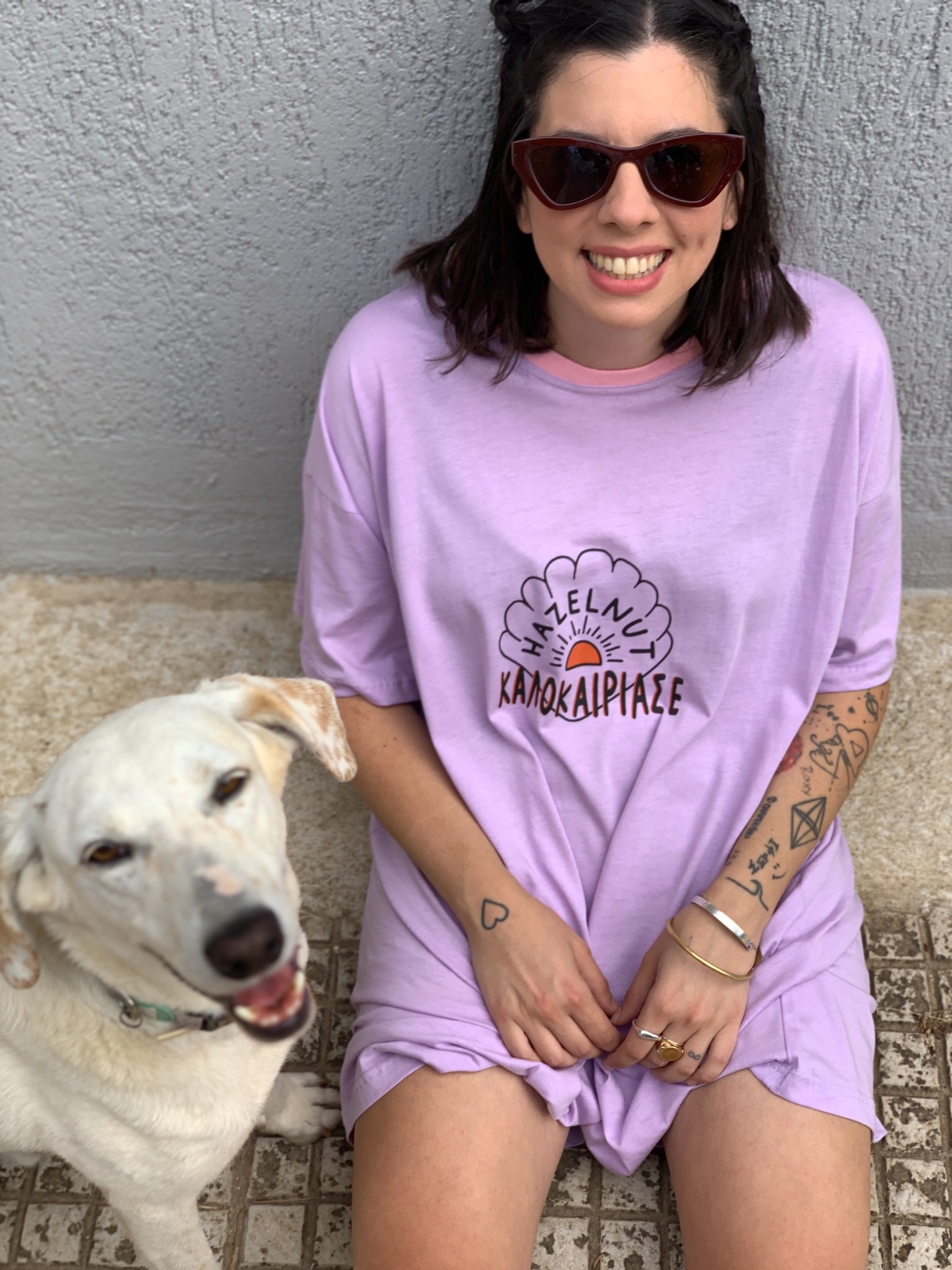
Starting your own business at 22 sounds exciting. You have your ideas, your creativity, the thrill of finally doing what you love. Then the first bills arrive.
For Roxanne, at least, that was the first real reckoning when she began working for herself.
“The debts!” she replied when we asked when she first truly felt like a business owner. “From the very first month!”
It was not necessarily the answer we expected, but it was probably one of the most honest we could have received.
Roxanne, who runs Hazelnut with her sister, does not describe entrepreneurship as an endless success story. She talks about what actually comes with it: money, working relationships, the need to be taken seriously, the pressure of social media and the difficulty of setting boundaries around something you love.
When we met her online for GYNĒMA, we wanted to learn more about her art. But the conversation grew into something much broader. We talked about mental health, the way women are treated at work, expectations of motherhood and a collaboration with women who needed an opportunity to earn a living.
Somewhere along the way, we found ourselves asking whether it is worth pursuing what other people call success.
From school to drawing—and eventually Hazelnut
For Roxanne, the question was never really whether she would pursue art.
She knew what she wanted to do while she was still at school. There was no alternative career that interested her as much. Making things was simply the next step she wanted to take.
That did not mean there was an easy way to get there.
After school, she worked in cafés to pay for her studies at Vakalo. As she described it, the financial side of her future business was not something she thought much about then. She was young, enthusiastic and certain of what she wanted.
Years later, she would describe money as one of the most difficult parts of her work.
And not just because of the expenses.
“I find it really difficult to talk about money and ask for money,” she told us.
For a long time, she struggled to put a price on what she made. Some people treated her drawing as a hobby rather than professional work, expecting her to make something for very little—or even for free.
The trouble was that she had begun to accept that way of thinking herself.
Over the years, she has been trying to change that: to ask for better pay and recognise that her time, creativity and labour have value.
She did not tell us she had entirely mastered it.
Perhaps that is what makes her answer so interesting. A woman who has built her own business has not necessarily stopped doubting herself, or always learnt how to ask for what her work deserves.

When personal experience becomes art
Before we turned to business, we asked her something different: if someone saw her work without knowing anything about her, what might they understand about the person behind it?
Her answer was mental health.
For quite some time, she explained, she struggled to find her own artistic style. But when she began drawing on her personal difficulties and experience of anxiety, she started to find a form of expression that felt more like her.
Art became a way to process her own experiences, as well as what she noticed in the people around her.
We were particularly drawn to this, because we so often see only the finished piece: a drawing, a garment, an object. We think less often about the experiences that might lie behind it.
For Roxanne, the two seem closely connected.
Hazelnut is not a faceless company with a large team behind it. As she explained, it is her and her sister. They are the ones at the markets, speaking to customers and representing their brand every day.
Naturally, that makes their personal and professional identities difficult to separate.
Creating something that reflects who you are can be wonderful. But there is another side: when your work is so closely connected to you, even a comment about it can feel deeply personal.
Roxanne explained that people often struggle to separate the maker from what they make. Someone might dismiss a piece because they dislike its creator—or appreciate someone’s work without identifying with their personality.
For a small business built around its people, that connection is even stronger.


“They thought I was stupid before they even knew me”
When the conversation turned to her experiences as a young woman in business, Roxanne did not need long to think.
She described her earliest collaborations with manufacturers, mostly older men, who, she felt, looked down on her from the outset.
She was young, a woman, tattooed, and working in an environment where she constantly had to prove she knew what she was doing.
Before she could explain what she wanted to create, an opinion of her had already formed.
What struck us, though, was how she described the people she chooses to work with today.
In recent years, she has deliberately worked with women: artists, photographers, videographers, social media professionals and other creatives.
She did not present this as some grand revolutionary gesture. It was more a choice that felt right to her, allowing her to work with people around whom she felt comfortable.
The conversation also brought up another, less expected prejudice.
As she told us, people often assume that a woman who has built her own business will automatically be snobbish, distant or difficult to work with.
“Girls have told me they expected me to be more distant,” she said, wondering why anyone would form that impression without knowing her.
A young woman may be seen as insufficiently serious to run a business. Yet once she builds something of her own, she can suddenly be seen as too aloof or difficult.
Whichever way she turns, there seems to be something to judge.
Running a business does not mean wanting a prescribed life
Our discussion of social expectations naturally led to another subject: motherhood, and the way we continue to connect a woman’s personal choices with her professional life.
At the time of our conversation, Roxanne was 35 and in a relationship. She told us she did not currently want a child and had chosen to focus on her art and work.
Yet she often encounters the assumption that a woman who invests so much in her business must be neglecting her home or family.
She finds that these comments tend to come more often from older generations.
We told her how similar attitudes still surface at school: comments from other students, outdated ideas about gender roles and the expectation that a girl should manage everything without complaining.
Roxanne recalled her own school years. She told us she often argued with boys about these issues, and emphasised the influence of family life.
A child can grow up taking it for granted that a woman will look after the home and everyone in it, while a man has more time and freedom for his own activities.
We did not agree on every point in exactly the same way. That was not the purpose of the conversation.
What mattered was that two generations of women could recognise similar expectations, even when they encountered them in different settings.
When support becomes more than words
One of the most interesting moments came when we asked what genuinely supporting other women meant to her.
At GYNĒMA, we often use words such as solidarity and empowerment. They matter to us, but we know how easily they can remain nothing more than attractive phrases.
Roxanne told us about Hazelnut’s collaboration with a group of women in vulnerable circumstances. Several had migrated to Greece and were facing particularly difficult living conditions.
Some had experienced abuse; some had children. They were taking part in sewing and Greek-language learning activities.
The Hazelnut team visited the place where they were being accommodated and decided to work with them professionally.
They did more than make a donation. They commissioned pieces for a homeware collection and paid the women for their work.
Roxanne described this as one of the most meaningful initiatives she had been involved in.
The reason was simple: these women did not only need help. They also wanted an opportunity to work.
Listening to her, we thought about the distance between talking about supporting women and creating real opportunities for them.
Solidarity does not always lie in major campaigns or public statements. It can be a paid collaboration, recognising someone’s skills, or making room for them to create and build an independent working life.
And, as Roxanne reminded us, it can mean listening without judgement.
What if success looks different from what we imagined?
Towards the end, we asked a question that matters to us as two girls trying to build something of our own.
If we set aside followers, sales, collaborations and the image of a successful businesswoman, what would success mean to her?
Her answer had little to do with business.
She told us that, as she gets older, she increasingly wonders whether success really means owning a thriving company—or feeling free and happy within yourself.
Then she described her ideal alternative life.
A small house on a farm. Her animals, her friends and a little community of people living together.
A commune, as she called it.
It was an unexpected image with which to end a conversation about building a brand. Yet it also seemed entirely consistent with everything she had told us.
Behind her love of creating was a need for a life that did not revolve entirely around work.
She spoke about the anxiety that can accompany professional success, the feeling that you must always stay a step ahead, and how easily other people’s opinions can affect you.
Even at markets, she told us, she hears frequent comments about her work—positive and negative. Comments people may imagine the makers do not notice.
“We hear everything,” she said.
However hard you try not to let it affect you, it is not always easy.
Perhaps what changes with time is not so much our ambitions as our definition of success. Building something of your own can be wonderful. That does not mean it has to become your whole life.
“We need to be there for one another”
Before we finished, we asked Roxanne to leave us with a thought for the women who would read her interview.
She returned to solidarity between women.
She spoke about the difficult experiences women of different ages and backgrounds can share—and the need not to turn those experiences into another reason to judge one another.
She wanted us to listen to each other more. To understand before judging. To stand beside other women, even when their choices differ from our own.
She described a “circle of love” in which women would protect one another.
It felt like the right place to finish.
Roxanne did not try to present a perfect picture of entrepreneurship. She told us about the debts that brought her back to earth at 22, her difficulty asking for the pay she deserves, the prejudice she encountered and everything she is still trying to understand as she gets older.
That was what made the conversation so compelling.
Behind a brand we may admire on Instagram are real people: creative, uncertain, navigating everyday difficulties and holding hopes that do not always fit the image of a “successful woman”.
We left the conversation holding on to the idea that we do not need to have achieved everything already for what we create to matter.
And, of course, that supporting other women does not necessarily mean doing something enormous.
Sometimes it begins with taking them seriously.
This article is a narrative account of the interview, rather than a verbatim transcript. It draws on the experiences and information Roxanne shared; opinions and personal accounts are attributed to her.
The English version is an editorial adaptation of the Greek original. Quotations have been translated from Greek.
Personal reflections on mental health are not professional advice.
More interviews and features